
Drink Responsibly
Alcohol is the most commonly used drug in Australia and often a big part of social gatherings and celebrations. However, it’s important to be mindful of your alcohol intake, understand your limits, and make informed choices so that you can enjoy social occasions while minimising the risks associated with alcohol consumption.
What are the
risks
associated
with Alcohol?
Alcohol consumption carries several risks that can impact both your physical and mental health. Short-term risks include impaired judgment and coordination, which can lead to accidents and injuries. Excessive drinking can also result in alcohol poisoning, a potentially life-threatening condition.
Long-term risks involve chronic health issues such as liver disease, including cirrhosis and liver failure, as well as an increased risk of high blood pressure, heart disease, and certain types of cancer. Alcohol can also contribute to mental health problems, including depression and anxiety, and can negatively impact your relationships.
How much is too
much?
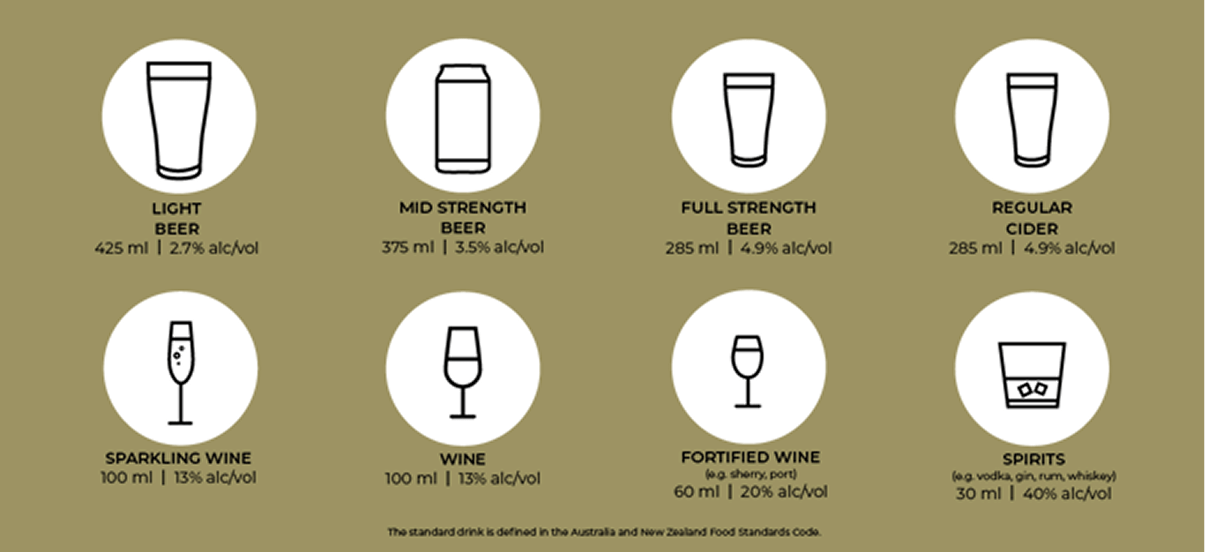
Whilst there is no completely safe amount of alcohol, Australia’s National Health and Medical Research Council (NHMRC) recommend that alcohol intake should be limited to no more than four standard drinks on any given day, and no more than 10 drinks a week.
To make it easier to understand what a ‘standard drink’ is, the NHMRC provides the below guide:
Are You Worried
About
Your Drinking?
If you are worried about your drinking, there is a good chance that you are drinking too much or too often. Read through the statements below and if any apply to you, you may have a problem with alcohol and need to make some changes.
- You regularly exceed the guidelines of four standard drinks a day, or ten standard drinks a week.
- You find it difficult to go a day or two without alcohol.
- You drink to help you sleep and/or be confident in social settings.
- People close to you are worried about how much you drink.
- Your drinking is causing problems with relationships (family, friends and/or work.)
- You think a lot about alcohol.
Self Help Strategies
Like many things, drinking can become something we do out of habit. Try some of these suggestions below to help change your drinking habits and feel better:
Track your consumption
Track your alcohol consumption with a journal or mobile app so you can identify patterns. In addition to how much you are drinking, make notes on how often, how you are feeling, where and who you are with. If you can, try and identify what circumstances may trigger you to drink, such as certain emotions, social settings or people. If you can identify a pattern, you can develop strategies to avoid or manage triggers.
Set achievable goals
Set achievable goals to reduce your drinking. Be specific so that you can accurately track your progress, celebrate your achievements and then build on them. For example, you may choose to cut down to no more than 4 drinks a week or limit yourself to two alcoholic drinks at social events. Changing habits can be hard so start with small steps to achieve success.
Non-alcoholic options
Stock up on non-alcoholic options such as mineral water (even think about purchasing and using a sparkling water maker), coconut water, fruit juices or even the ingredients for mocktails. Having tasty, non-alcoholic alternatives readily available at home will help you beat cravings and keep on track with your goals.
Find rewarding activities
to do instead
Identify enjoyable and rewarding activities that you can turn to if you have cravings to reach for a drink. It could be going for a walk, doing something creative or calling a friend.
Exercise
Engage in regular physical exercise to reduce stress, anxiety and release endorphins to naturally improve your mood and wellbeing.
Communication
Communicate your goals and need for support to trusted friends and family and be specific about how they can support you. This might include not drinking alcohol around you, meeting at alcohol free venues or just being available to listen and encourage you if you need to talk.